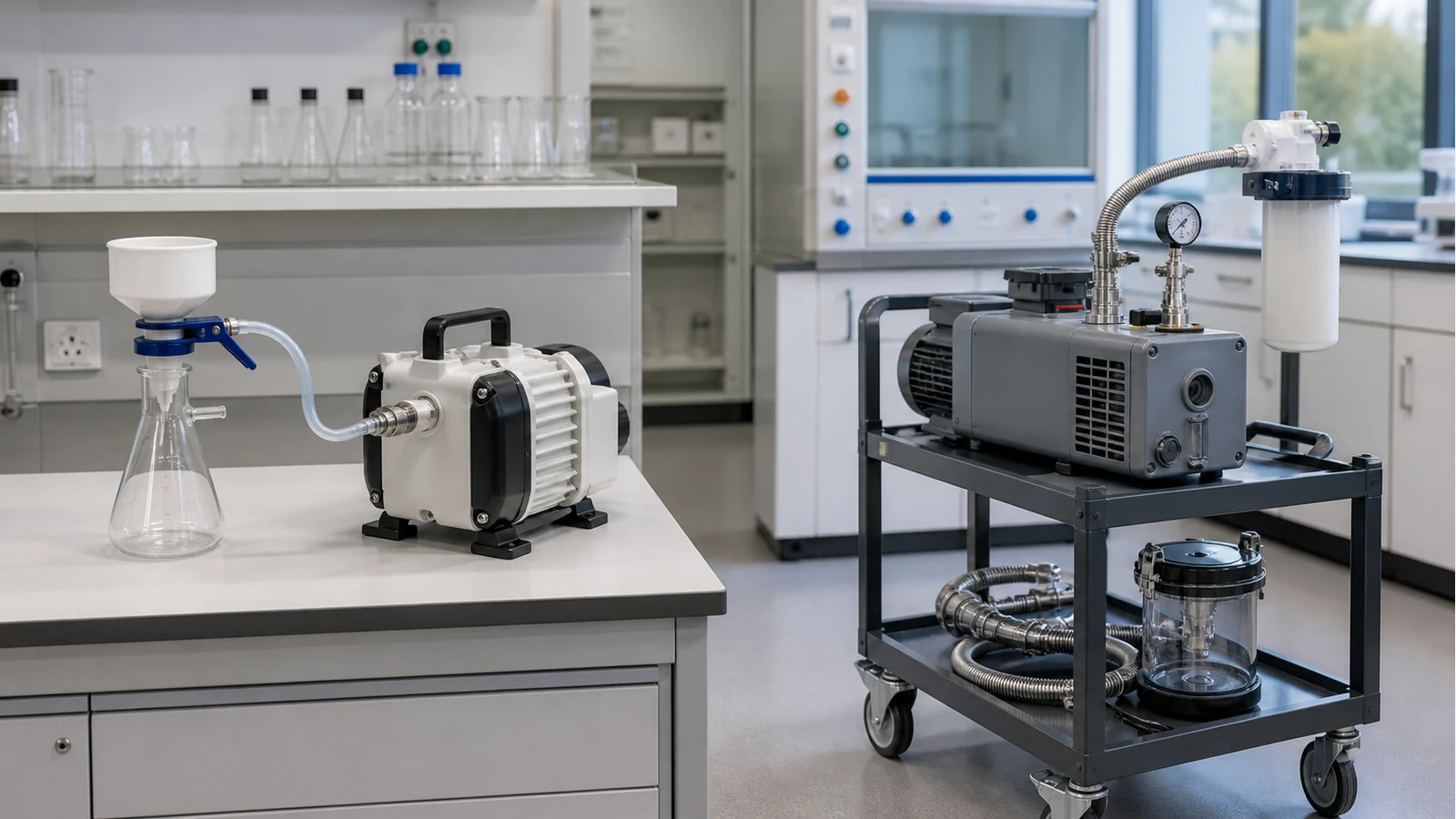
Diaphragm Vs Rotary Vane Pump For Lab Filtration Uk
Direct answer: routine Buchner filtration, aspiration and many aqueous sample-prep jobs usually belong with an oil-free diaphragm pump. Rotary vane pumps earn their place when the job genuinely needs deeper oil-sealed vacuum, such as some freeze-drying, Schlenk-line and vacuum-oven duties.
The mistake is buying the deepest vacuum source because it sounds more capable. In a filtration workflow, that can add oil handling, mist control and maintenance without improving the everyday job the bench actually performs.
Task-matching table
| Lab job | Usually better starting point | Reason |
|---|---|---|
| Buchner filtration of aqueous mixtures | Oil-free diaphragm pump | Moderate vacuum, clean operation and easy bench placement matter more than deep vacuum. |
| Buffer or mobile-phase filtration | Oil-free diaphragm pump | The contamination and maintenance burden should stay low. |
| Simple desiccator pull-down | Often diaphragm or piston | Many desiccators are moderate-vacuum, low-flow tasks. |
| Freeze drying or Schlenk-line work | Rotary vane or other deeper technology | The process may need deeper vacuum and appropriate accessories. |
| Solvent evaporation | Chemistry-rated controlled system | Chemical resistance and vapour handling become central. |
What UK selection guidance says
MUNRO Scientific maps filtration to moderate-vacuum choices such as diaphragm or piston pumps, while associating rotary vane pumps with deeper applications including freeze drying and Schlenk lines: MUNRO Scientific pump selection guide. That is the useful split for procurement: start from the process, not the pump catalogue category.
VACUUBRAND UK similarly separates filtration-type rough-vacuum work from other laboratory duties and discusses diaphragm pumps in that rough-vacuum context: VACUUBRAND UK guide to the right lab pump.
The oil question
Rotary vane pumps are proven tools, but oil is part of the operating model. That can mean oil changes, oil mist control, contamination concerns and more operator training. Labcompare notes the broader move toward oil-free dry pumps where deep oil-sealed vacuum is not essential: Labcompare vacuum pump buyer guide.
For a teaching practical or small QC filtration bench, oil-free operation removes several steps where users can make avoidable mistakes. It does not remove the need for a catch pot, correct hose, or a clear shutdown routine.
When not to choose the small diaphragm route
Do not use a filtration-class pump as a substitute for a deep-vacuum pump just because it is cheaper. If the method specifies a pressure range, aggressive vapours, heated solvent removal or a validated deep-vacuum process, the procurement answer is a suitable system for that process. For a common misapplication, read why a filtration pump is not a rotovap shortcut.