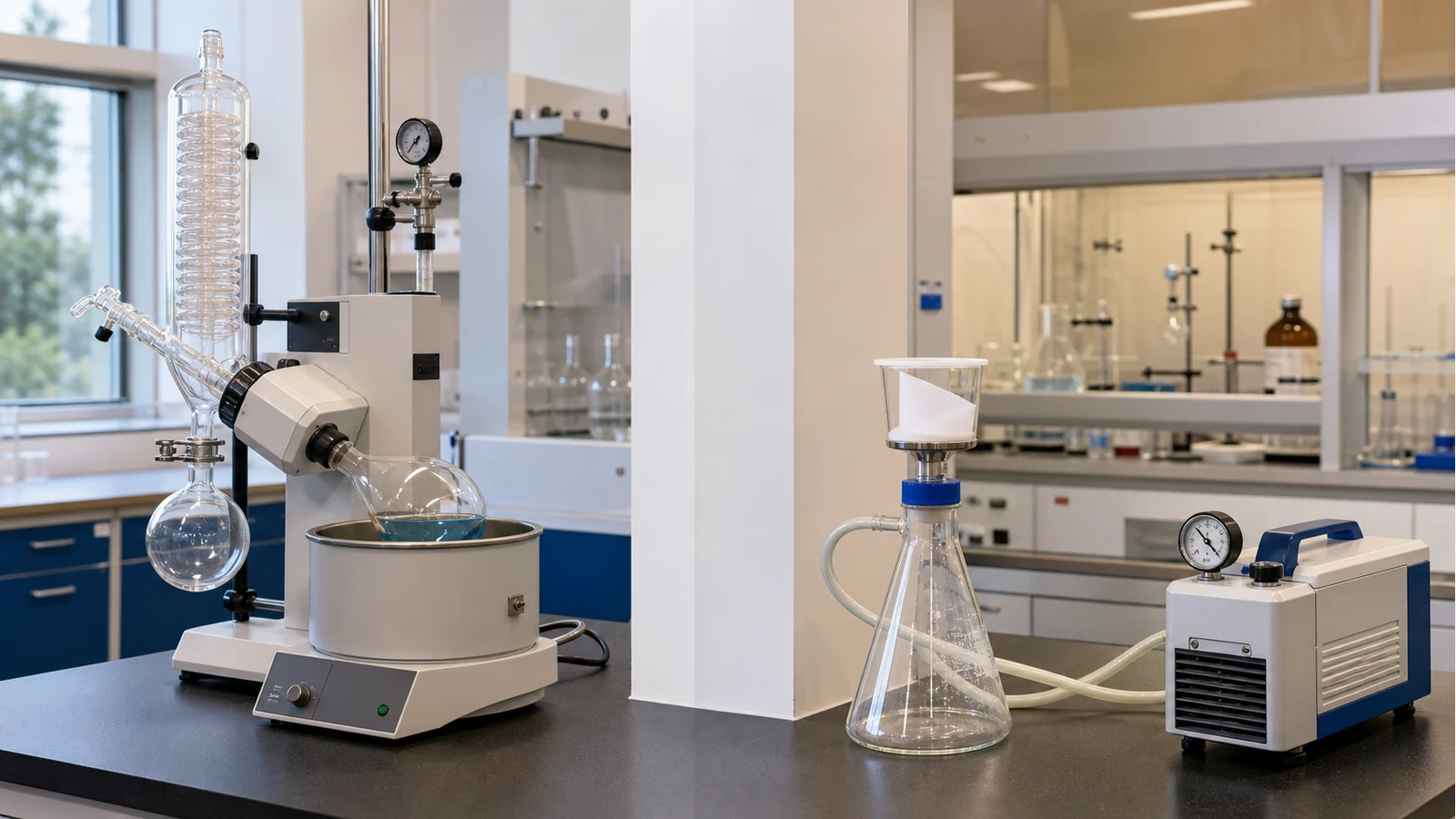
Filtration Pump Not For Rotary Evaporation Uk
Direct answer: a compact filtration-class diaphragm pump is for moderate suction jobs such as Buchner filtration, aspiration and some clean desiccator duties. It should not be treated as a general rotary evaporator pump for solvent-heavy evaporation.
The danger is not just that evaporation may be slow. The bigger issue is job mismatch: vapour load, chemical resistance, vacuum control and ultimate pressure all matter once a rotovap enters the workflow.
Stop if any of these are true
- You are evaporating aggressive or unknown solvents.
- The method needs controlled pressure rather than simple suction.
- The pump materials and wetted path are not confirmed for the vapour.
- The process needs deeper vacuum than a filtration pump can document.
- You expect the pump to run as part of a solvent recovery workflow.
Use the pump lane system
Divide the bench into lanes. The filtration lane covers Buchner flasks, aqueous sample filtration, some aspiration and simple clean suction work, with a catch pot where liquid could be pulled over. The evaporation lane covers rotary evaporators, solvent vapours, controlled pressure and chemistry-rated pump materials. Those lanes should not share a pump unless the pump is specified for both duties.
MUNRO Scientific warns that a pump intended for one application may be unsuitable for another, and highlights rotary evaporation as a case where chemical resistance, vapour handling, ultimate pressure and control need attention: MUNRO Scientific on choosing a lab vacuum pump.
Why catalogue categories matter
UK retailer application tables can be useful because they show how manufacturers separate duties. The Lab Store's Edwards D-Lab page groups single-head diaphragm models around filtration, desiccators and water-jet replacement, while deeper multi-head models are placed against rotary evaporation: The Lab Store Edwards D-Lab application table.
That does not mean one brand's table certifies another product. It means the application split itself is normal: filtration suction and rotovap vacuum control are not the same buying problem.
Where a filtration pump still belongs
Keep a filtration-class pump on dedicated Buchner work, clean sample filtration, aqueous prep and simple suction stations where the method does not require solvent-vapour compatibility or deeper controlled vacuum. Add a catch pot if liquid could enter the line, and document the "not for rotovap" boundary in the bench SOP.
VACUUBRAND's selection content also separates filtration media from evaporation and chemistry-rated diaphragm requirements: VACUUBRAND UK pump selection guide.
Next decision
If the job is ordinary filtration, compare diaphragm and rotary vane choices in the lab filtration pump comparison. If the job is evaporation, stop shopping by price alone and ask for the pump's chemical compatibility, vapour handling, control method and documented pressure range.