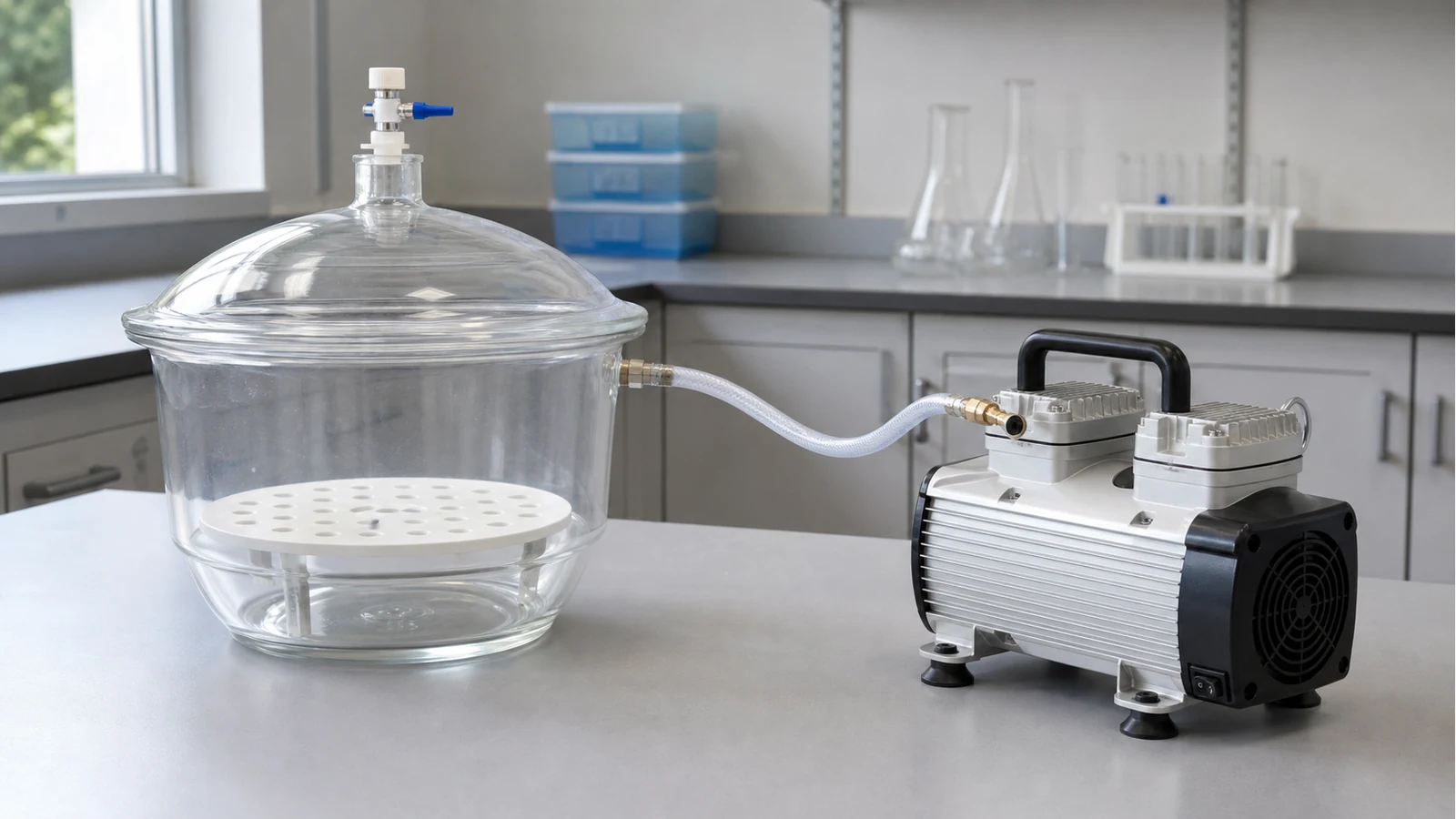
Oil Free Vacuum Pump For Laboratory Desiccator Uk
Direct answer: many simple laboratory desiccator jobs need moderate vacuum and low flow, so a compact oil-free diaphragm pump can be enough. It is not the right shortcut for large heated vacuum ovens, aggressive vapours or methods that specify deeper controlled vacuum.
For busy research groups and teaching prep rooms, the practical question is whether a simple drying job should wait for a shared deep-vacuum pump. Often it should not, provided the desiccator task is genuinely modest and the station is set up cleanly.
Good-fit desiccator schedule
| Use pattern | Why an oil-free pump can fit | Check first |
|---|---|---|
| Intermittent pull-down after samples are loaded | Low flow demand once the vessel is sealed. | Seal condition and hose fit. |
| Teaching prep-room drying | Clean, quiet bench operation is useful around staff and students. | Clear SOP and no unattended misuse. |
| Clean aqueous sample drying | No oil mist and simpler maintenance are useful. | Condensate risk and trap need. |
| Shared bench overflow | Keeps simple drying off the high-end pump queue. | Whether the required vacuum is only moderate. |
Evidence for the moderate-vacuum boundary
MUNRO Scientific lists desiccators as moderate-vacuum, relatively low pumping-speed applications suited to compact oil-free diaphragm or piston pumps: MUNRO Scientific vacuum pump selection guide. The Lab Store's Edwards D-Lab page also groups vacuum filtration and desiccators with single-head oil-free diaphragm pumps as water-jet replacement duties: The Lab Store D-Lab pump applications.
Those sources support the broad fit, not a universal guarantee. Your method, sample and vessel decide the final answer.
Set-up checklist
- Inspect the desiccator seal before blaming the pump.
- Use hose that fits the pump and desiccator ports without stretching or kinking.
- Add a trap if condensate or liquid carryover is plausible.
- Keep the pump ventilated and away from loose bench clutter.
- Do not leave a pump running unattended unless your local SOP and equipment documentation allow it.
When to upgrade instead
Use a different system when the process is a vacuum oven, solvent-vapour drying, aggressive chemistry, or a validated method with a stated pressure requirement. Labcompare summarises the general appeal of oil-free dry pumps for clean operation and reduced oil maintenance, but that benefit does not replace application matching: Labcompare vacuum pump buyer guide.
When the same-site pump route is relevant
If the job is a compact, clean, moderate-vacuum desiccator or filtration bench and your own method does not require chemical-duty evaporation hardware, review the same-site 10 L/min oil-free diaphragm vacuum pump against your vessel, hose and trap requirements. For filtration-specific protection, use the catch-pot checklist.