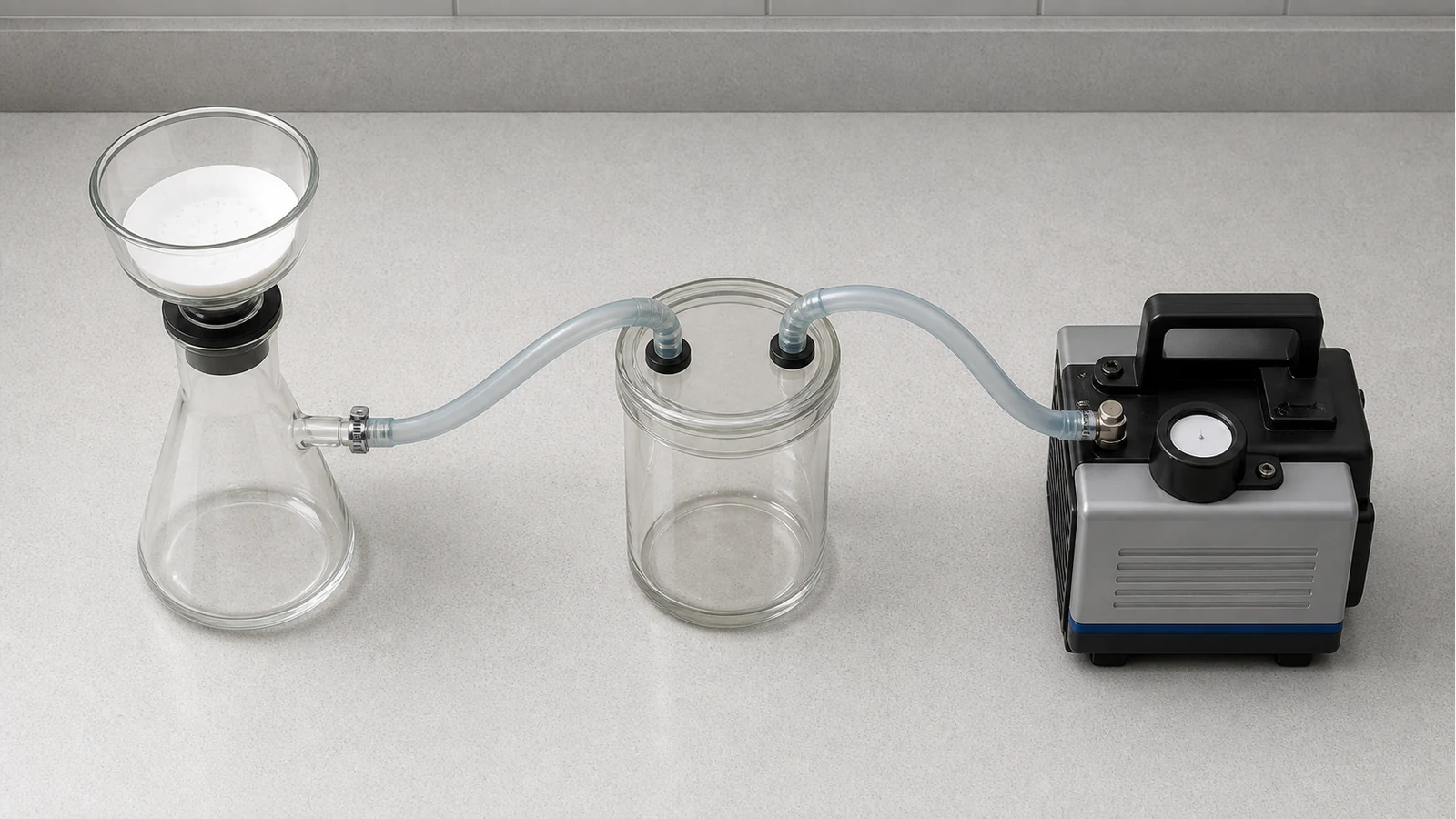
Vacuum Filtration Catch Pot Checklist Uk
Direct answer: put an in-line catch pot between the Buchner flask and the diaphragm pump before every student, research or QC filtration run. It is the simple physical barrier that gives liquid somewhere safer to go before it reaches the pump inlet.
A catch pot is not decorative glassware. It is the part of the station that absorbs real human behaviour: a flask filled too high, a hose pulled too low, a hurried demonstrator, or a sample that foams when vacuum starts.
The five-minute bench checklist
- Clamp the filtering flask. A side-arm flask under vacuum should not be free to rotate when the hose is moved.
- Place the catch pot between flask and pump. The hose should run from the flask side-arm to the catch pot, then from the catch pot to the pump inlet.
- Keep hoses short and visible. Avoid loops that dip below the bench edge or pull against glass joints.
- Empty and inspect the trap before use. A full trap is only a delay, not protection.
- Start gently and break vacuum before shutdown. Let the filter bed settle, then vent the flask before switching off or disconnecting.
Why this matters
Teaching-lab guidance warns that pumps lose effectiveness if non-gaseous material enters the inlet, and it separately notes aspirator backflow risk. The lesson is the same for both vacuum sources: the liquid path needs an interruption point. The University of York explains the core vacuum-filtration risks here: University of York vacuum filtration guidance.
Commercial filtration-pump packages often pair pump protection with a catch pot and regulator because the failure mode is predictable. Camlab's filtration pump listing shows that catch-pot and soft-start thinking are normal parts of a protected filtration setup: Camlab filtration diaphragm pump example.
What the catch pot does not prove
A catch pot does not make an ordinary pump suitable for aggressive solvent vapours, rotary evaporation or deep-vacuum work. It is a liquid-ingestion safeguard for a filtration station. If the liquid is volatile, chemically aggressive or heated, the pump selection needs a chemical-duty review, not just another piece of glassware.
Failure signs to stop on
- Liquid appears in the line after the trap.
- The pump note changes suddenly during filtration.
- The flask is more than comfortably below the side-arm level.
- The trap has not been emptied since the previous group or batch.
- The hose is soft, kinked, loose or pulling sideways on the glassware.
Welch filtration application guidance identifies accidental liquid ingestion as a primary failure mode and recommends using a catchpot between filtering flask and pump: Welch filtration application note.
When a compact pump is relevant
If your bench is a dedicated Buchner or aqueous sample filtration station, and you can add a separate catch pot where the checklist requires it, a compact oil-free diaphragm pump may be a practical vacuum source. The relevant same-site product route is 10 L/min oil-free diaphragm vacuum pump; check your trap, hose and application boundary before treating it as a complete station.
For the broader vacuum-source choice, compare this checklist with the water aspirator comparison.