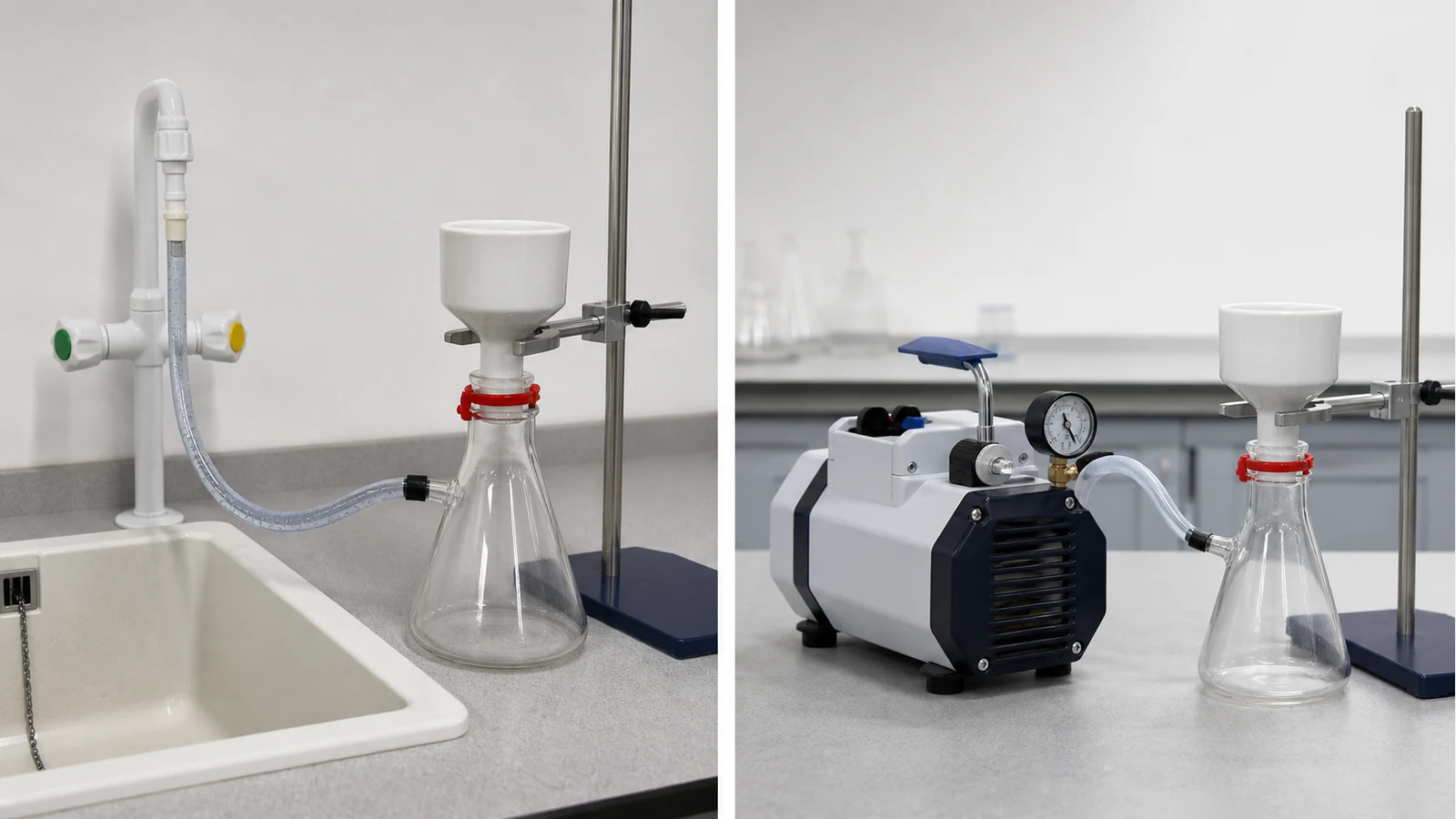
Water Aspirator Vs Oil Free Diaphragm Pump Uk
Direct answer: for routine Buchner filtration and clean aqueous sample work, a small oil-free diaphragm pump is usually the more predictable vacuum source than a tap-driven water aspirator. Keep an aspirator only where bench power is unavailable, filtration is rare, or the lab has deliberately chosen a water-jet setup and manages backflow risk.
The choice is not about which device can create suction in theory. It is about what happens on a busy UK teaching bench or small QC bench when water pressure changes, students disconnect hoses, a flask fills too far, or a technician has to reset the station quickly before the next group arrives.
What changes in daily use
University teaching guidance treats both water aspirators and vacuum pumps as normal vacuum-filtration sources, but it also flags two practical failure paths: water can be drawn back from an aspirator if pressure changes, and vacuum pumps lose effectiveness if liquid or other non-gaseous material reaches the inlet. That makes trap placement and operator discipline part of the decision, not an afterthought. See the University of York vacuum filtration guidance for the teaching-lab context: University of York vacuum filtration guidance.
| Decision point | Water aspirator | Oil-free diaphragm pump |
|---|---|---|
| Vacuum consistency | Depends on water supply and tap conditions. | Depends on the pump, hose seal and trap layout. |
| Water use | Consumes running water during operation. | Uses electricity, not a continuous water stream. |
| Backflow path | Water backflow is a known risk when pressure changes. | Liquid ingestion is the main risk if the flask or trap is mismanaged. |
| Bench setup | Needs suitable tap access and drainage. | Needs 230V bench power and a sensible hose route. |
| Best fit | Occasional simple work beside a controlled water source. | Dedicated filtration stations, teaching practicals and repeat sample prep. |
Why many labs move away from water aspirators
The strongest operational argument is not a dramatic performance claim. It is repeatability. Lab Manager discusses water aspirators as a high-water-use legacy choice and frames oil-free vacuum pumps as a cleaner replacement route for filtration-depth work: Lab Manager on replacing water aspirators. For a teaching lab, that usually means fewer variables for demonstrators to police. For a QC lab, it means the vacuum source is not tied to tap behaviour at the moment a batch has to move.
There is still no free pass. A diaphragm pump should not be asked to swallow filtrate. The practical pairing is pump, thick-walled hose, clamped side-arm flask and an in-line liquid trap. If the station is for students, the trap should live with the station rather than in a shared drawer.
When a diaphragm pump is the simpler answer
Choose the oil-free pump path when the bench runs Buchner filtration every week, multiple users share the equipment, water use is under scrutiny, or you need a portable station that is independent of tap position. UK lab supplier guidance places oil-free diaphragm and piston pumps among the common moderate-vacuum options for filtration and aspiration work: MUNRO Scientific guide to choosing a lab vacuum pump.
Do not switch blindly if the lab has no safe bench power, if the work is truly occasional and already supervised beside a suitable tap, or if the actual job is solvent-heavy evaporation rather than filtration. In those cases, solve the job definition first.
Practical next step
Before replacing an aspirator, map one real filtration station: tap or power position, hose length, side-arm flask height, liquid trap placement, who empties the trap, and how vacuum is broken before shutdown. That short check usually reveals whether the lab needs a cleaner dedicated pump or just better control of the existing setup. For the trap-focused setup, see the catch-pot checklist.